
The Tregeseal stone circle occupies moorland where granite monuments have witnessed countless winter solstices. Archaeological research increasingly demonstrates these weren’t randomly placed but carefully positioned according to astronomical principles understood by Neolithic communities. The Land’s End peninsula emerges as a deliberately designed landscape for tracking the sun’s annual journey.
Geological and archaeological evidence converge in revealing ancient intentions. The peninsula’s granite backbone runs southwest, matching the direction of winter solstice sunset. This natural alignment appears to have been recognized and utilized by monument builders who integrated landscape features with celestial observations, creating functional astronomical installations that also served ceremonial purposes.
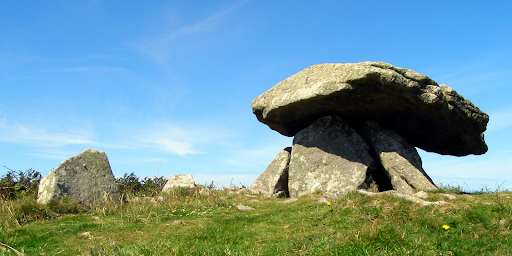
Chûn Quoit exemplifies this sophisticated approach. The chambered tomb’s location ensures winter solstice observers see the sun setting precisely over Carn Kenidjack’s summit. Such precision requires sustained observation over many years and suggests astronomical knowledge was valued and preserved within these communities, likely transmitted through specialized practitioners.
From Tregeseal circle, the Isles of Scilly appear as fluctuating presences on the southwestern horizon. Their visibility varies dramatically with atmospheric conditions, sometimes appearing close and detailed, other times vanishing completely. This instability may have reinforced symbolic associations between the western horizon, the setting sun, and concepts of death and renewal central to solstice meanings.
The peninsula’s enigmatic holed stones present ongoing archaeological mysteries. The Kenidjack examples feature small apertures positioned low to the ground, unlike the human-sized hole at Mên-an-Tol. Research suggests possible calendrical functions, with sunlight streaming through the holes creating changing patterns that helped communities track the approach of winter’s darkest day. Modern celebrations including guided walks and the vibrant Montol festival maintain these ancient connections between community, landscape, and celestial cycles.